Friday, April 16, 2010

More Chardin

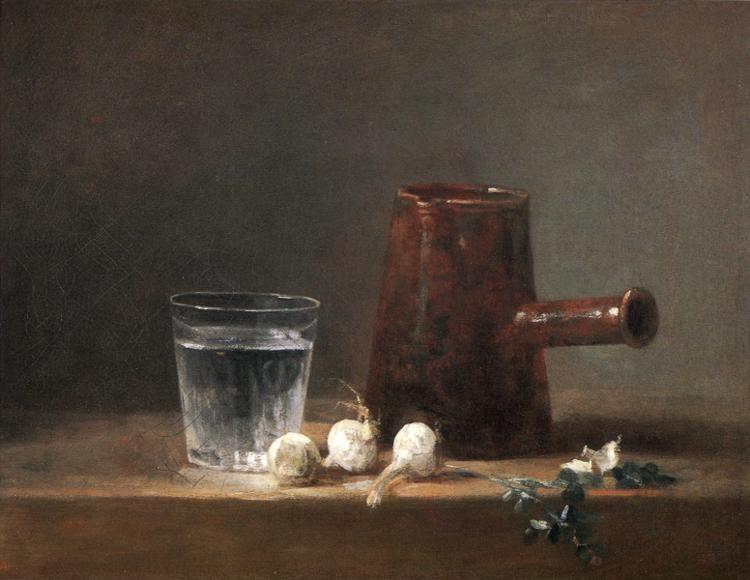
I'd rather ignore the dishes in my kitchen in order to look at a few more of Chardin's. Above is A Glass of Water and a Coffee Pot. (c. 1760)

I didn't know that Proust loved Chardin, too, but now I see why that should not be surprising.

"You have already experienced it subconciously," (Proust) wrote, "this pleasure one gets from the sight of everyday scenes and inanimate objects, otherwise it would not have risen in your heard when Chardin summoned it in his ringing commanding accents." (p. 215)


As Michael Kimmelman puts it in The Accidental Masterpiece, Chardin's style was "extravagant understatement."

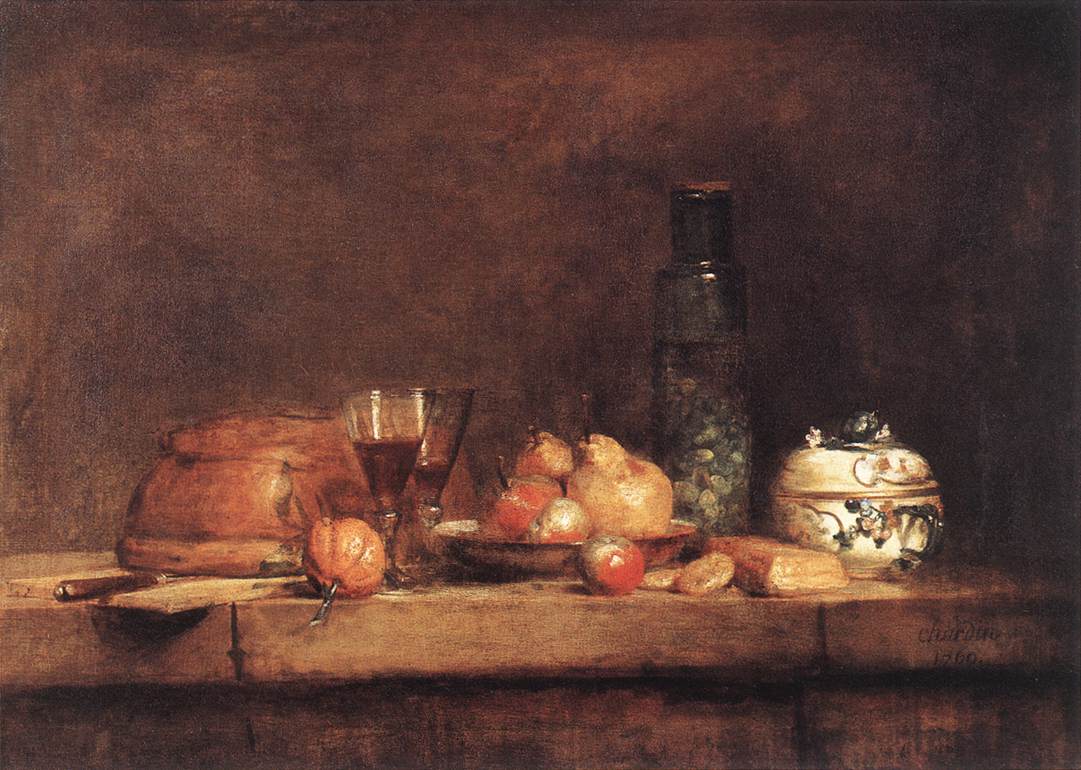
Over and over Chardin returned to pots, pans, onions, and eggs, finding something lovely and harmonious in the simple, homey objects. "The art historian Michael Baxandall has pointed out how, by causing viewers to linger over his various little objects, Chardin was subtly devising works that have multiple points of focus, and thereby expressing contemporaneous theories about how we do not take in complex space all at once but instead piece together the accumulated perception of different colors and shapes." (p. 218) Here's Still Life with Jar of Olives.


What do you think? Does this make sense?

Wednesday, April 14, 2010


Michael Kimmelman's book, The Accidental Masterpiece, On the Art of Life and Vice Versa, is one I pick up from time to time, and always find something to think about. Above is Soap Bubbles.

Every great painter is great by his or her own terms, Antoine Watteau's terms differeing from Gustave Courbet's, Jacques-Louis David's from Wassily Kandinsky's. Chardin was as great as any artist by the terms he set for himself, which were incredibly narrow: for almost his whole career, spanning half a century, nearly every minute of it spent in Paris, Chardin focused on what was not much farther than three or four feet in front of his nose. . . .Chardin's people are maids and schoolteachers and wives, absorbed and inward turning, oblivious to us. Their absorption becomes the emotional essence of the work. (p.215)

He feels they are not the same as Vermeers, bathed in light, kind of other-wordly figures. Rather these people are real and solid, not so ethereal. What I didn't notice at first is that the compositions are relatively spare; every detail is not included. This seems to contribute to the serenity of the works.


As far as Kimmelman is concerned, Chardin had absorbed the philosophies of the times, understanding Locke and Newton. Kimmelman says critics have pointed to the paintng, Lady Taking Tea, as proto-modern "because the figures in them seem so completely absorbed in what they are doing, modernism exulting in the inward-looking autonomy that defines pure abstract painting". So perhaps the painting "is not just a picture of a woman drinking tea but a a mediation on our perception of a woman dringing tea. . . it's a picture about seeing, in other words." (p. 217)

What do you think?

More on him in the next post, I think. I'm interested in learning more about how Chardin influenced Cezanne and delighted Proust.

My daughter is always pestering me about my subjects, saying, how about doing a teapot? So far, no teapots.

Monday, April 12, 2010

I wish I still lived in LA, because I would definitely want to go to the reception this Thursday night at the Andrewshire Gallery on Wilshire Blvd. My former teacher at Otis, Franklyn Liegel, will be part of an exhibition called Mind Game. At left is a detail from Clandestine Gaudi, a piece that will be in the show.

As you can see, he works in collage and assemblage and creates richly layered pieces. Some of these are from previous exhibitions. (These blue pieces are posted on this blog spot called Said and Done.)


You can see that he does not limit himself to simple rectangles. In class, we experimented with all kinds of canvas combinations, including diptychs with panels of uneven sizes. At left is Barcelona Dwelling. This and more pieces are posted on the Art Center site (where he also teaches).


I've had a number of teachers who are able to help with technique, but most can only show you how they paint. Franklyn was the only teacher who seemed to be able to help each student start finding his/her own style, and the first to help me realize how important it is to immerse yourself in images, to look and look, until you see what it is you respond to.

Do you say "break a leg" with an art opening? Probably not. So, thank you and congratulations, Franklyn.

Friday, April 9, 2010


Kids are on school break so there's less time for posting - I will punt by posting some recent paintings by an obscure painter living in the NW - me. Here are several I've been working on for the Urban exhibit at the Seattle Art Museum Gallery coming up. Do they look suitably urban?
This is Work Zone:


This last is Front Window/Monorail. Maybe they all would benefit from provocative, cool titles, of which I have none. . .


Wednesday, April 7, 2010

"For me nothing is abstract. In fact, I believe there is nothing more abstract than reality." Giorgio Morandi

Giorgio Morandi is in the business of subverting the conventions of seeing. It makes perfect sense that he loved Cézanne, who had a related desire to strip things down, to see them again as if for the first time. Morandi shares Cézanne's acute attentiveness and desire to lift off the veil of convention from visual experience, but there is in Morandi something belated, something beyond the present moment that is not found in Cezanne. The very last paintings in this show are almost like afterimages: those blots of shape and color and light that remain even after you have closed your eyes to the things themselves. In these last works, the relations between objects and empty space, between solid form and air, between the edge of one thing and another are persistently questioned. (from Mysteries of the Rectangle, Siri Hustvedt, p. 131)

I've liked Morandi ever since my Franklyn Liegel, my teacher at Otis, brought a book with Morandi still lifes to class. But of course I've never been able to figure out why I liked them. Hustvedt does seem to devote the time to looking at art. (She talks about her 11 year-old daughter coming to the museum with drawing paper, knowing that they'll be hunkering down for hours in the gallery, in this case the Peggy Guggenheim Gallery in Venice.)

Anyway, Hustvedt overhears a bewildered man who enters yet another room ahead of his wife, and turns to call to her, "More bottles!" Then comes the wife's reply, "I told you. They're all the same." They're right, but Hustvedt is interested in figuring out what it is Morandi is seeing.

Above is Still Life with Yellow Cloth (1952). She does a much more complete job of untangling all the possibilities explored in Morandi's work, but for this short space, I'll mention what I found most compelling. What she is struck by is the relationship between the shapes, how a symmetrical object has become asymmetrical on the canvas. Other critics have wondered if his still lifes seem to resemble Italian cityscapes, with their earth tones, their architectural look, their horizon lines. She seems more intrgued by the soft lines of hard objects, the way the lips of some of his bowls wobble and bend like the cloth nearby. In this painting, she points out the black shadow area between the brown bowl and the white jar, and how the light illuminating this group of objects would not be strong enough to create such a black, black shadow. It's as though he's created another shape with that shadow that stands on its own - because he's interested not just in the things, but in the spaces between them. (p. 123)

As a painter who has been interesting in a reductive approach, I was struck by this comment as well: "He did not feel that by reducing the numbers of the objects he painted, he reduced the range of his vision. On the contrary, the very narrowness of the field became the vehicle of his liberation. This is a modernist position. As for Giacometti, as for Beckett. . . reduction opened up possibilities that inclusiveness did not have. From a few things, you get everything." p. 132

Is this making sense? What do you think?

(P.S. to Julie - what is the name of the novel on Morandi?)

Monday, April 5, 2010

"When am I going to turn blond?" Carolyn, my black-haired daughter, when 4.

"Up until then, I had not considered that a black woman could be considered as a goddess of love and beauty. Even I took the classic European ideal for granted." p. 14*

I came across these words of painter, photographer, and printm
aker Kerry James Marshall in a book that surveys decades of work through the year 2000. (Marshall teaches at the University of Illinois.) Here is Blue Water Silver Moon (1991), acrylic and collage:


There's something so graceful and beautiful about that pose. I like that her head almost blends in completely with the upper edge of the image. And those circles - why do they work so well? Describing another painting, Marshall talked about the challenge of maintaining a sense of dimension while trying to make his figures as flat as possible. To get that density, he said he sometimes painted the black figures as many as eight or nine times, trying to find as many combinations of warm and cool blackness as he could, "to make them breathe more." (p. 90)

Below is Voyager (1992), with its themes of birth, death and journey.

Marshall often likes to combine elements of history and references to contemporary culture in his work. It's hard to see the detail because some of it is so light, but the name of the boat, the Wanderer, was evidently a luxury schooner that was refitted in order to transport slaves. The last slave crossing from Africa to Georgia was made by this ship in 1858.

"The male figure is fugitive, largely obscured by the sail, while the female sits prominently in the ship's prow, garlanded with roses. The work is embellished with delicate line drawings derived from Afro-Cuban nsibidi and anaforuana signs and symbols used in religious ceremonies. . . .Haitian vévé symbols. . . and medical illustrations of embryos." (p. 15)

I'm sure you noticed the nsibidi right off the bat - actually I had no idea what all these symbols were. I need more obvious clues, like the skull at the bottom.


This last one is Bang (1994). In the book, Marshall talks about the irony of the African American experience of holidays, and how it seems to him that it is Black people who seem to celebrate the holidays most vigorously, barbecuing on the 4th and so on.

(There's an interesting short article about the controversy this painting caused when the curator of an insurance company's collection (Progressive Corp.) hung this painting near the cafeteria in the Cleveland headquarters. The artist came to the site to discuss and defend his work. Click here for more on this.)

Do you know his work? What do you think? I usually resist work with political or social themes somewhat reflexively, but I am drawn to his with their layered imagery and visual complexity.

* Kerry James Marshall, text by K. J. Marshall, essay by Terrie Sultan, conversation with Arthur Jafa, Harry N. Abrams Inc., 2000.

Thursday, April 1, 2010

It's Good Friday, I have dinner for 16 to plan for on Sunday, and I've done absolutely nothing beyond making a list and pulling a few weeds in the yard. So I think it might be wise to simply post a few of these portraits by not-so-heralded Cecilia Beaux, contemporary of Sargent and just imagine some of these folks are on their way.

At left is Sita and Sirita, (1893). Who does she look like? I think the answer is Emily Blunt, at least around the eyes. Here's a close-up:


This is Ernesta (Child with Nurse) 1894:

Here below is the Last Days of Infancy (1883-85). The subjects are her sister and her nephew. If you do not have guests coming and/or are have a much tidier house, you might want to click on this Last Days link to read more about how this painting was entered in the Paris salon exhibition and led to the beginning of Beaux' international fame. (Doesn't Cassatt have a similarly posed portrait? Found it - see at the very bottom, it's Little Girl in a Blue Armchair, 1878.)


An entirely different approach with Cassatt - maybe this is the after Easter relaxation pose: