
Monday's post included a sculpture by Bernar Venet that I came upon in a magazine. He joins the long list of sculptors I knew very little about. The challenges of sculpture, of course, are the same as with painting - what to do when it's all been done?
In an essay he wrote in the seventies, Venet discussed the philosophical underpinnings of his work:
For Venet, there was an overabundance of nonfigurative and figurative imagery in the visual arts. Indeed, he thought that they had been done to death, and that the only way to rescue art from itself, from entropic redundancy, was by basing it on the mathematical graph- which for (Jacques)Bertin was the only true monosemic image. It is a completely rational model, Venet wrote, arguing that art must become "solely a place of manifestation of a code." (ArtForum, February 2003)
ArtForum's Donald Kuspit continues: Is it correct, then, to consider Venet's sculptures and drawings in this exhibition as illustrations of this code and, as such, conceptual? Are they a kind of applied mathematics? Not entirely. Each of Venet's "Arcs," 1976- (not included in this show but see image below), is a measurable segment of a circle's circumference, usually accompanied both in the title and work itself by the mathematical formula that "describes" it. But Venet also makes "Indeterminate Lines," 1983-, which he regards as "free" and "not definable mathematically"-thus wittingly subverting his own premises, as though to signal that rendering a code artistically is implicitly irrational. . . . .the graph line becomes convulsive and eccentric, seeming to lose its bearings. It becomes playful and unpredictable. . . . Indeed, it becomes a grand gesture-an eloquently dramatic expression of space. As Venet says, "randomness is one of the rules of the game," which produces at least the appearance of absurdity, "freeing sculpture from the constraints of composition."
Above intederminate line (rolled steel, 1994). Here are Arcs from the 2009 Venice Biennale:
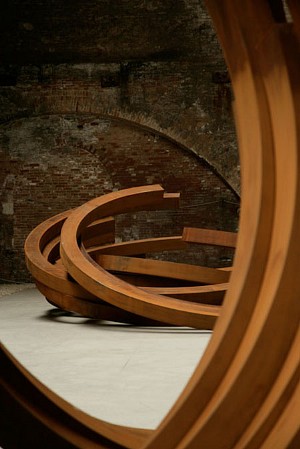
If you go to his website, you'll see that he provides both a brief and a detailed biography. Naturally, I went for the brief version, but there were so many tantalizing tidbits that I had to go back and read the detailed version.
Here are a few: "Creates a ballet, Graduation, to be danced on a vertical plane" and later, "decides, for theoretical reasons, to cease producing art."
The bare bones are: born in France in 1941, is incredibly versatile and following the hiatus from art, works in a wide range of media: painting, sculpture, soundwork, furniture, and photography.
I'm always very wary of anything that seems gimmicky, so I was kind of surprised to like the 15- second video sound piece that pops up automatically when you click on his website. Sounds like church bells; makes you want to be part of the action. What do you think?


 Posts
Posts


