Showing posts with label Degas (Edgar). Show all posts

Monday, February 8, 2010

Since 2/1, we've been looking at the ideas in A Fine Disregard, Kirk Varnedoe's book on what makes modern art modern. He believes "the modernity of Degas's picture (Place de la Concorde, left) does not lie just in some step it provides on the way to Matisse and to Stella."

Varnedoe combed through scores of stereoscopes to see if Degas would have "found" something similar to his Place de la Concorde painting and appropriated it. He concluded that nothing available to him in the world of photography had the same "sense of reality, this world of the odd and contingent, of the accidental and the ephemeral,this offbeat sense of the crazy street." Varnedoe believes that his painting is "neither the product of photography's nature nor a given of modern society, but a construction willed into being by an artist." (Keep in mind that Kodak did not come out with a camera capable of producing snapshots until 1888. Place de la Concorde was painted in 1875.)

Here's The Vision After the Sermon (Jacob Wrestling with the Angel), 1888 and Munch's Evening on Karl Johan Street , below, (1892):

Varnedoe feels this Gauguin work is clearly indebted to Degas: "the near-space enlargement of the peasant woman beholding this hallucinatory vision of Jacob wrestling with the angel is a modified transcription of Degas's cafe-concerts and theatre pieces. He feels that those large, confrontational foregrounds in this and in the work of Munch are not really rejections of Realism; it's a tweaking of Realism's conventions, a way of turning up the volume on selected aspects of Realism --not so much a break with tradition as an offshoot.

In this matter of traditional versus modern spatial structures, and borrowed versus created innovations, The Vision After the Sermon helps us focus on some basic questions of originality. The composition here is taken from Degas, the line quality owes a lot to Daumier, the branch comes out of Hiroshige's plum branch, the wrestling couple is lifted from Hokasai's sketchbooks, and the flat planes of color and bold outlining derive from contemporary stylistic experiments by Gauguin's younger associate Emile Bernard. Yet the picture was boldly original. It's a "cobbling together of something new out of a grab bag of local and imported pieces." (p. 94)


And what about Matisse? Looking at Harmony in Red, Varnedoe sees it as a reimagining of an old theme - the comforts of home. I could paraphrase, but he says it better:

By enlarging the repetitive simplified swags of the wall pattern, and giving both that design and the intense red such dominion over the relatively thin and spindly imagery of nature seen through the window, he imparts a near-ecstatic pulse of life to what ot
hers might see as a quiet modest moment of decorative table preparation. In every respect, the opulence in this picture, the thrilling, engulfing energy that spills out of its borders, is tied to the simple act of arrangement at its center; it has to do with the immense enrichment of human life through culture, conceived not in terms of the additive piling-on of acquisitions, but in the attentive reconsideration of what lies to hand. (Apparently he had owned that piece of fabric for years, using it in other paintings as a backdrop.)

The eliminations and simplifications - the reduced detail, or most notably the minimized cues for depth - are pursued with this end in view - of reopening, rather than narrowing, the play between what we know and what we discover, between our awareness of a limited set of conventions and our ability to enlarge our response to life through their manipulation. (p. 95)

Are you at the blah, blah, blah point? Does this make any sense to you? Or is this heading off into rather high-flown, enigmatic realms of philosophy?

While most of this makes sense to me, it seems what matters is whether you need all this critical background to feel that expansiveness when you look at Harmony in Red, or whether it just works and you're transported, engulfed in that strong color. What do you think?


Friday, February 5, 2010

If you're just joining the conversation about the ideas of the late Kirk Varnedoe and what makes modern art modern, you might want to go back to the two previous posts starting on 2/1 to catch the thread.

We talked about how Degas "discovered a world of space in the peculiar margins of perspective conventions" that others had noticed but not used in their art (A Fine Disregard, K. Varnedoe, Harry Abrams, Inc.). Volumes have been written about how Van Gogh, Gauguin, and others were greatly influenced by Japanese prints, primarily those of Ando Hiroshige. But Varnedoe thinks that artistic influence went in the circle.

Here's Plum Estate by Ando Hiroshige (1857). Van Gogh produced a painting almost identical to Hiroshige's but he also adapted the looming foreground in this painting, Spring in Arles, below,(1889).

While Varnedoe provides a lot more background than I have room for here, much of what he says boils down to this: "The tradition in which One Hundred Famous Views of Edo was made was a tradition of Japanese engagement with Western perspective."

He cites a book by historian Henry Smith who points out "long before there was Japonisme in Europe, there were waves of European influence in Japan." The first wave was in the 1600s, primarily with religious art. The second wave was in the 1730s and included Dutch books with interior views, landscapes, and anatomical charts. He believes the Japanese were fascinated by perspective and began to copy, but without understanding all the principles.


Some Japanese artists, like Shiba Kokan, produced "fully perspectival views," but others felt free to splice together aspects of perspectival systems, resulting in images that have figures, objects or still life grafted onto scenes depicting deep space. (pages 56-57)

It's Varnedoe's theory that as these Japanese artists experimented, they solved problems in their own ways and became quite inventive in their rather flexible approach to perspective.
"One solution to the problems Hokasai had. . . was to give up on the
ideal of a continual recession into space." (p. 57) Notice the splice of foreground directly over the background view of Fuji in his famous The Great Wave off Kanagawa.


By the time you get to Hiroshige, working later than Hokusai, you're noticing some comic inventions with perspective, such as Naito Shinjuku, Yotsuya, in which the horses hindquarters are looming in the foreground. (Apparently Shinjuku was a brothel area outside Edo, and poetry going back decades mentioned the mixing of two aromas - p
erfume of the courtesans and odor of the horse manure.)


Below is Degas' Racecourse, Amateur Jockeys (1876), with Hiroshige's Ushimachi, Takanawa beneath it.


Varnedoe is not suggesting that the Europeans simply copied the Japanese, but that perhaps a number of things were brewing at once (including some borrowing from the earlier Realist tradition). He thinks the Europeans, and Degas in particular, were more than responders, inventing in their own way, and that Degas was constantly moving figures around, taking a figure from one painting, a staircase from another, and trying something new every time he made a picture. He thinks that Degas and others probably figured out the same things the Japanese did - "that you do not have to construct space as a deep stage and coherently organize everything to fit consistently into it; if you layer together little and big elements, foreground and background parts, and leave out the transitional middle ground, the viewer will use these clues to fill in the binding, overall space."

Here's The Ballet from 'Robert Le Diable' (1876) - only foreground and background!


In fact, Varnedoe points out that Degas had been splicing elements together for years, as early as this painting, Woman Leaning Near a Vase of Flowers, 1863.

He says, "Mechanically, in fact, in the Woman Leaning, Degas seems to have begun with a perfectly normative and conventional conception of a flower still life; then he added a little of another, portrait convention, and the result became something that alters both parts, and will not settle down into either norm. The portrait aspect now involves a sense of personality that depends on the dialogue between her sense of inwardness and the expansive beauty of the still life, and suggests thereby a whole different format for showing being and surroundings, person and place, as interconnected bearers of identity."

Of course, there's much more in A Fine Disregard but I fear I'm running on too long.

He discusses the innovative compositions of Munch, Caillebotte, and Gauguin, all taking bits and pieces of conventions which they were now familiar, and rearranging them in new ways to make paintings that produced a different world view, a different mood, or a new way of looking at the individual in society.

Maybe Gauguin and Matisse deserve a day, and then that will be enough on his ideas about the "road to flatness" and what makes modern art modern.


Time to start work on a horse's hindquarters series. . . actually I have an opening reception today for an exhibit so I need to get out the door. Looking forward to hearing your thoughts.


Wednesday, February 3, 2010

Continuing today with a look at the ideas of Kirk Varnedoe*. In his book, A Fine Disregard, he talks about what he feels are deficiencies in the most common approaches to understanding modern art. (See 2/1 post.)

Before talking about Degas' Place de la Concorde, Vicomte Lepic and his Daughters, (1875), it might be a good idea to spend just a second explaining the commonly accepted ideas about how modern art developed. Varnedoe says:

There has been a kind of ortho
doxy, inculcated in countless devotees, about how it all came to be; and the doctrinaire version of that story, of Edouard Manet who begat Paul Cezanne who begat Pablo Picasso, in a march out of servile naturalism into the promised land of abstraction , explains what has happened in art since 1860 about as adequately as the seven days of scripture account for the fossils in the Devonian shale. . . . Any account of modern art's origins has to tie together a bewildering variety of objects and events, from Manet's urbane spaces and Claude Monet's landscapes, through styles as disparate as Paul Gauguin's flat color and Georges Seurat's dots, to the more hermetic departures of Picasso and Georges Braque in Cubism. The tendency has been to describe all these "rapid-fire changes as a march of progress and explain the welter of new forms as revelations of necessary truths." There was a belief by some of these explainers, that there must be sources in science, mathematics, mysticism, primitive art, and so on, that formed the basis for these truths.

At the same time, others looked to other explanations, primarily having to do with a distillation of each art form as it "moved toward a purer and purer nature." Still others explained modern art by looking at the social context of the artist and his/her times. Was Seurat commenting on a problem of leisure time in Paris? (Sunday Afternoon on the Island of La Grande Jatte, 1884-6), above left. What about Manet's bar scenes? Were class distinctions being examined?

Varnedoe thinks all of these approaches are either incomplete or just do not work.

We do not have to agree either with Seurat's color theories or with his anarchism to find profound human content in his landscapes, any more than we have to
be Einstein to be fascinated by Cubist portraits. And only an infinitesimal percentage of those who jammed Picasso's 1980 retrospective at The Museum of Modern Art, or who have come to stand before Pollock's drip paintings in various degrees of bewilderment and thrall, cared an iota about the historical destiny of the picture plane. And yet people . . .have found in these odd and difiuclt things a rich spectrum of meanings and uses. . ." (p.20)

Modern art, he says, "did not originate in the wholesale overthrow of all conventions. . .It has been the product of individual decisions to reconsider the complex possibilities within the traditions available (to the artists), and to act on basic options that were, and remain, broadly available and unconcealed."

So Degas, in Place de la Concorde (Vicomte Lepic and his Daughters), did not find a photograph with the quite common feature of a loomin
g distorted foreground and just try it out. He was already somewhat in the habit of assembling his compositions by moving elements around quite freely. He just made some new choices. In composing this painting, he has made a series of decisions - to crop the figure at the knees, to place the figure of Lepic off center, to move the horizon higher - but not, Varnedoe asserts, because he saw all this done in photographs. For whatever reason or reasons, he was feeling freed from the constraints of perspective, of creating a foreground, middleground, and background, in his compositions. So he made a modern picture:

What's odd about Lepic (in Degas' painting) is that he is striding past without looking at us, so that we have a portrait's intimacy with a narrative, genre aspect added to it. And what's even odder is that it is set in the middle of a cityscape. The cityscape is not so odd. The portrait is not so odd. The genre scene is not so odd. What is new and crucial is a portrait-cityscape-genre scene, which is the form of something unknown; a new sense of the engagement of a private personality with a public space, a new sense of how one might define singular personal identity in modern Paris. (p.88)

I know this is getting long, but I want to add that the influence of optical
devices was not new. Several centuries before, Canaletto would have been set up with his device in the Piazza San Marco, and as Varnedoe points out, a number of Lepics would have wandered by in the foreground. But he would have ignored them; he did not choose to paint a figure looming in the foreground. At right, Piazza San Marco, 1757.

There's more, to this, of course, that brings in the influence of Japanese prints. But Varnedoe thinks we have this backwards, that the influence began when Japanese artists saw European pictures composed using perspective. More Friday. Would love to know what you think of all this, or if you already came upon these theories when they were first published.


*Varnedoe, who died in 2003, was the Director of the Dept. of Painting and Sculpture at the Museum of Modern Art, NY. Prior to that, he taught at Stanford, NY University's Institute of Fine Arts, Columbia, and Williams College.

Monday, February 1, 2010


Well, having discussed the influence of Japanese prints on the work of Van Gogh a few months ago, I will now proceed to eat my hat. In my most recent attempt to understand modern art, I just started reading A Fine Disregard: What Makes Modern Art Modern by the late Kirk Varnedoe. With great excitement after only a few pages, I flipped to the beginning to find the publication date. . .1990. Oh well, the ideas seem new to me! (Have you read this? Or the more recent compilation of his lectures published posthumously in 2006, Pictures of Nothing?)

Anyway, in the opening pages he refutes two broadly accepted ideas: that the invention of photography greatly influenced the work of Degas, Caillebotte, and others of the time, and that European painters started heading on the "Road to Flatness" because they were so taken with the look of Japanese prints.

Before looking at what Varnedoe has to say (later this week), it might be a good idea to explain the title. He writes that back in the 70s he traveled to the north of England where he studied a marker erected on a grassy playing field. It says:

This stone commemorates the exploit of William Webb Ellis, who with a fine disregard for the rules of football as played in his time, first took the ball in his arms and ran with it, thus originating the distinctive feature of the Rugby game. A.D. 1823

Varnedoe borrows this metaphor of grabbing the ball and changing the direction of the game and uses it throughout the book. He believes artists have made changes that grew out the conventions and traditions of the time, and rather than breaking sharply with those traditions, they've grabbed pieces of what was at hand, sometimes literally right on their drawing tables, and used those odd bits in new ways to change the game and take art in new directions.

Above is Degas' Place de la Concorde (Vicomte Lepic and His Daughters), 1875. Next post will talk about Varnedoe's thoughts on what makes this painting modern and all that might have influenced a composition like this one.

Wednesday, January 27, 2010

"What a delightful thing is the conversation of specialists! One understands absolutely nothing and it's charming." Degas


Those words of Degas don't really relate to this post; I just loved that statement.

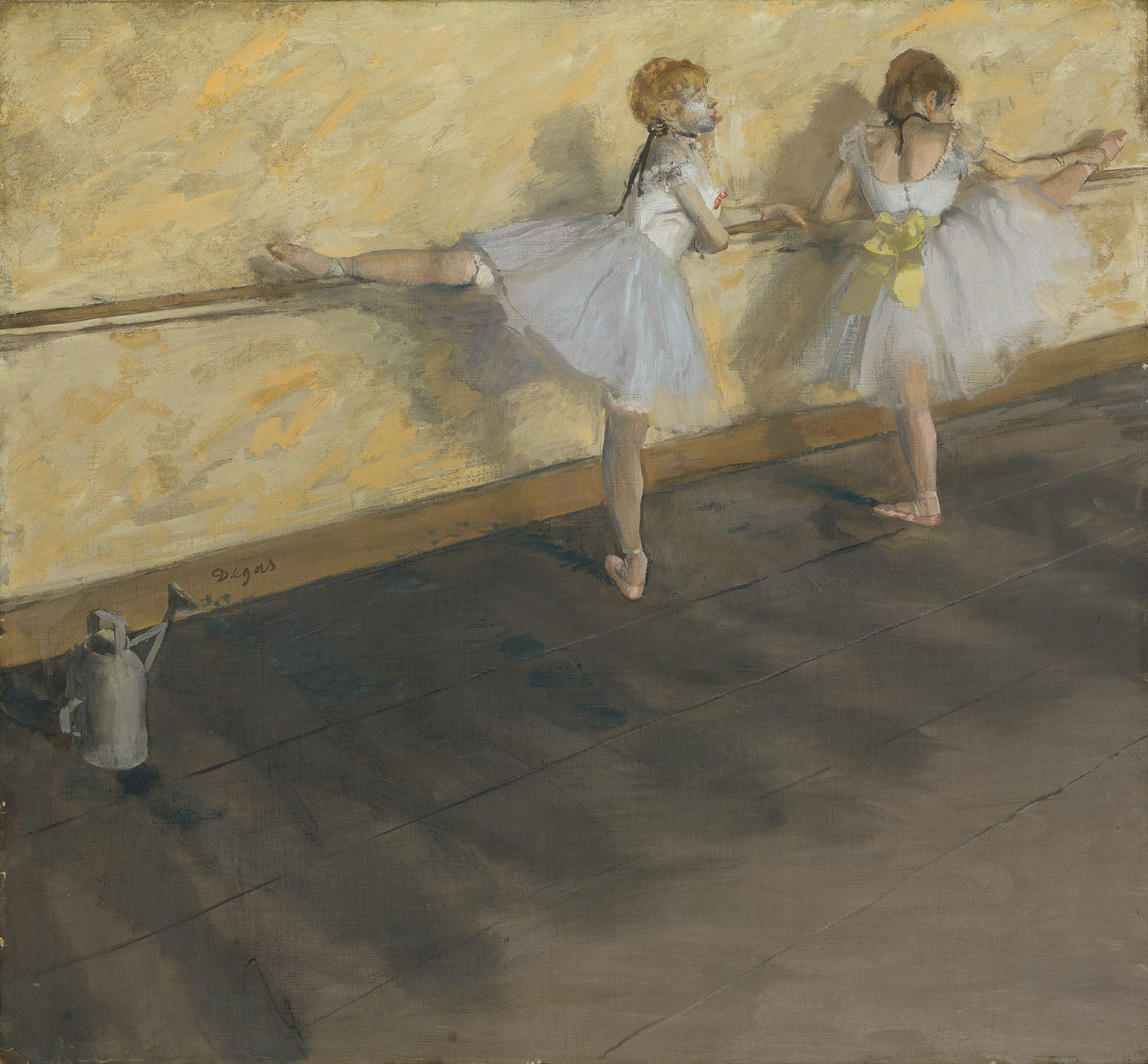
Isn't it almost as interesting to see what an artist omits as what he/she includes? Came across this Degas, Dancers Practicing at the Bar, (1876-7). Of course your eye goes right to that watering can that mimics the shape of the dancer. Degas later regretted including that can and wanted to paint it out. But, the owner of the work. who was also a friend of Degas, wouldn't let him do it.* (If you're wondering what a watering can's doing in a studio, apparently the can is used to spread dust on the floor for the dancers.)

As a painter you sometimes just can't stop looking at an element you decide is not right. I remember my Otis instructor, Franklyn Liegel, suggesting you block out the element (by putting one hand over one eye) and see if you will miss the element if it's gone. Trying it with this painting, I certainly don't feel I miss that can. What do you think? It must have practically ruined Degas' feeling about that painting, wanting to change it but not being allowed to do it.

*From Masterpieces of the Metropolitan Museum of Art, Yale U. Press, 1993, p.232

Tuesday, October 20, 2009

"The artist must live apart. His private life should be unknown." Degas

Jockeys in Front of the Grandstand. (1869-72)
Imagine if People or Us had been on the scene 150 years ago: Degas puts coal in the stove! He stops in a cafe for coffee! He goes to the racetrack!

Since these fine periodicals were not publishing in the 1860's, the next best way to learn why Degas would never have appeared on The Bachelor is to read The Private Lives of the Impressionists by Sue Roe.

Here's the info according to Roe:

He always stated that he had no desire to marry. 'What would I want a wife for? Imagine having someone around who at the end of a grueling day in the studio said, "that's a nice painting, dear." The glamorous, bejewelled women with bare shoulders and plunging necklines, hauled by their husbands from salon to
opera box then on to some glittering dinner party, dismayed him.

He felt a particular horror for the necks and shoulders of women past their prime. Seated next to one such lady at dinner one evening, he told his friends she had been practically naked, he could not take his eyes off her. Suddenly turning towards him, she had asked, 'Are you staring at me?' 'Good Lord, Madame', he replied, 'I wi
sh I had the choice.'

Degas did spend time with his contemporaries, but preferred to spend the better part of the day working alone in his studio.

Despite having a husband and 3 kids, somehow over the years, I have practically become a hermit. Doesn't work for everyone - some artists I've talked to get a lot of energy from their interactions with friends and co-workers. How important is solitary time to you? Can you have too much of it?

Here's Apres le bain, femme d'essayant la nuque.
(1898)