Showing posts with label Caravaggio (Michelangelo da Merisi). Show all posts

Thursday, May 20, 2010

I don't think it's always wise to look for the personal details of someone's life to show up in an artist's work, but it's kind of tempting with Artemisia Gentileschi. (No, she was not a butcher or anything. . .who's that contemporary chef/author, Julie of Julie and Julia fame, the one who wrote a book about butchery?)


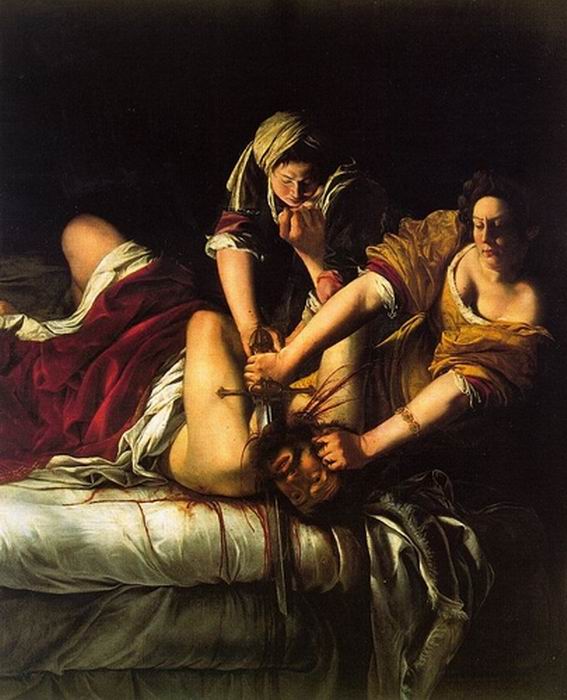
Here's Gentileschi's Judith Slaying Holofernes (1612-21). Apparently this portraitist and painter of religious scenes depticted this as many as six times. According to Dr. Robert Belton (Art, p. 248), Gentileschi was trained by her father and heavily influenced by Caravaggio. She follows his lead with strong lighting and a deep, black background.

Here's Caravaggio's from 1598, and what some critics have called a rather hesitant, squeamish Judith shrinking a bit from the task. Her maid looks rather up in years, especially compared to the stronger, younger maid in Gentileschi's version. In Art, Belton mentions an additional reason for the artist to focus on such a gory scene; as a 19 year-old Gentileschi claimed she was raped by one of the artist's in her father's workshop.


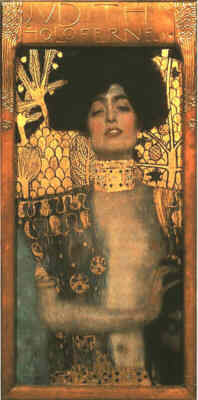
If you don't recall the Biblical story, here's a summary. In the Old Testament, the Jewish widow, Judith, saved the city of Bethulia from siege by the Assyrians by adorning herself and venturing into the enemy camp to gain access to the Assyrian general, Holofernes. He invited her to a banquet intending to seduce her, and while they were alone at the feast, Judith took advantage of Holofernes' drunkenness to decapitate him, and returned to Bethulia with his head in a sack. The Jews saw Judith as a virtuous heroine, but Klimt portrays her as a Viennese femme fatale. (from Wet Canvas)

It does seem as though you're yanked into the present day with Klimt's version. It's just arresting in its power, don't you think? You are drawn instantly to that face, but when you take a second to see those fingers, the picture has even more impact. Honestly, though, I don't think I would have looked at Klimt's as carefully if I hadn't seen Gentileschi's and Caravaggio's first. What is your reaction?
Wednesday, March 24, 2010


My brother-in-law, Fred Moody, sent me this funny story from the NY Daily News about how scholars have discovered that through the years, in various works of art, the portion sizes at the Last Supper have been super-sized, just as they have in life. But the article only included Da Vinci's fresco from 1495-8, leaving inquiring minds frustrated and looking for other works to study. So I did a little checking around to see what I could discover in the way of culinary evidence. You'll notice that only tiny rolls can be seen above. Maybe that's a platter of something on the right - hard to see on this screen. (Anyone have a larger version?)


A hundred years later, in 1592, the meal had morphed a bit in Tintoretto's version:


Okay, so this is actually a different meal, Caravaggio's Supper at Emmaus (1601), but they seem to have a quite a lot of food groups covered here:


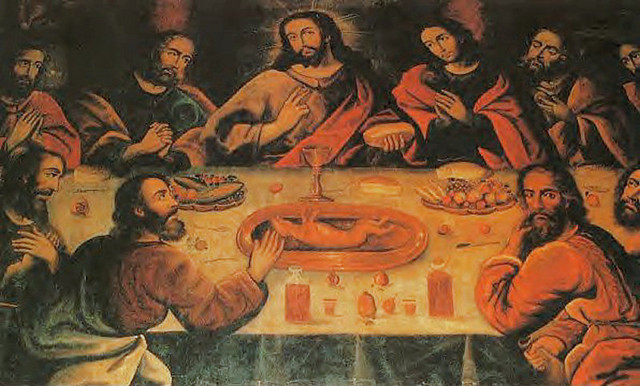
And lastly, this was created by Marcos Zapata in 1753, about a hundred and fifty years have Da Vinci's. By this time that bread is the size of a Subway sandwich, and not too unleavened looking either.


Credit for this photo: www.reflectionseurope.com.

The dish in the center looks like an alien life form but is actually a guinea pig, a local favorite in Peru where this graces the walls of the cathedral in Cuzco. A blogger pointed out what she believes is a resemblance between Judas (lower right) and conqueror Pizarro. She may be right. Here he is, at left.


If you're interested in following this trail any farther, I'll warn you that any Last Supper search online leads to a crushing number of versions and parodies, from the Simpsons to Star Wars.