skip to main |
skip to sidebar
 Augustine may not have been the first to say this, but the words are often attributed to him.
I first heard this at Loyola from a Jesuit priest who explained that there were a number of paradoxes from the time of Aristotle that puzzled philosophers and mathematicians for centuries. One such paradox states that "that which is in locomotion must arrive at the half-way stage before it arrives at the goal." (from Aristotle.) You can always divide a number in half, and so no matter what distance you have traveled, you will always have half that distance to go before you reach your destination. The paradox is refuted by contradiction: solve it by walking. Above is Sargent's Campo San Agnese, Venice with a lot of walkers, almost ghostly ones.
It certainly seems that I will never cover the distance, never finish the press releases, never re-size the images, never get the hanging wire on the last painting, and so on. Who doesn't feel this way? What else can you do but just push on, working as much as you can to halve the distance?
Apparently John Singer Sargent was capable of working for incredibly long stretches, "literally all day till the light failed." His sister's friend Eliza Wedgwood says "I was the drone of the party, but allowed to sit and watch John for hours at a time: I don't think he was conscious of my presence. . .he was so absorbed in his work that he was oblivious of all else. . . it was such an experience to see him paint, every stroke telling." (from Sargent in Italy, edited by Bruce Robertson.)
Yesterday as I rushed down from my studio to make lunches before school, I fell down the stairs, quite a lot of them. . . so maybe it's solve it by walking slowly.
A painting by John Singer Sargent that looks spontaneous and rushed but probably took some planning:

 One drawback of having young children at home, much as I love them, is that you don't get to go to Australia -- or anywhere else requiring long flights and extra money. At least not this year. Next best is leafing through Australian Painters of the Twentieth Century by Lou Klepac. Struck by the desolate paintings of Russell Drysdale who wanted to go off to serve in WWII along with his contemporaries, but was rejected due to the lack of sight in one eye. Hard to imagine today, but an army officer told him to "go and paint for your country." He turned his attention to the people who worked on this rather desolate land. Above is Man Reading a Newspaper from 1941.
Makes you think of Dali's Persistence of Memory which appeared ten years earlier, doesn't it? I like the playing with sense of scale, the low viewpoint, the man's elongated form. What are those objects off on the right? I guess they're fallen buildings. The landscape is not one that offers opportunity - the drought had left many in difficult circumstances.
Drysdale had successful exhibitions and achieved notoriety, but also suffered some devastating losses. In 1961 his son committed suicide; two years later his wife ended her life as well. According to Klepac, he managed to regain his stability, continue painting, and remarry several years later. Some years earlier he wrote to a friend about his experience as an artist:
I've never subscribed to the time-honoured role that an artist must subject himself to a ruthless discipline as a student or as a young man discovering the joy and power of self-expression - it is when he becomes an artist, when slowly through the experiences of his living and his training he becomes confident of himself and what he wants to say and his power to say it, that he must subject himself to discipline. And then one doesn't like that word: rather it is the beginning of a sensitive and very determined power of selection, the selection that places on the table the real gems from the intriguing heap that surrounds them. For an artist is not merely so because he is able to state one thing or another--he is essentially an artist firstly in that he shows an unusual selection and perception in what and how he states it.
(page 98, Australian Painters, edited by Klepac)
Case in point - Drysdale's Basketball at Broome - comes out of the much-ignored sub-genre of nuns coaching sports: 
 What about learning a new medium? Is it a dodge, a stalling for time when you fear you might be running out of ideas? I don't know. I'm hoping it's truly a worthwhile way to find some new working methods that will help when returning to oils or lead in a whole new direction.
Going to take an encaustic workshop taught by Patricia Baldwin Seggebruch whose encaustic work, entitled Shellacing 2 is above. In the Artist's Handbook, Ralph Mayer describes this ancient technique that's undergoing a revival, especially now that portable, cheap heating elements are available. A good deal of our information about the methods and use is found in the writings of Pliny, who wrote in the 1st century A.D.
In his writings, Pliny described the painting of mythological scenes on panels, portraits created with wax on wood, and the weatherproofing and decorating of war ships. By adding color to the wax, the painters could create tinted effects and because wax is a preservative, the work would last. Encaustic paintings do not yellow and the wax is impervious to moisture, unlike tempera.
The method is thought to have originated with the Greeks as far back as the 5th century B.C., so it was already 4 hundred years old by the time Pliny describes the work.
Pliny would have been a Pulitzer-prize winning journalist had he lived today, or at least a National Enquirer star. Apparently he was so curious to check out the explosion of Vesuvius that he got into a boat to move in closer and investigate. The fumes were too much for him and he died of asphixiation.
 I am just figuring out that sometimes a subject can be so captivating in all its details that it becomes a stumbling block to the making of an interesting painting.
In reading about his time in Morocco, it's clear that Matisse had no interest in producing a series of picturesque, ready-made scenes that might sell well back home in France. Twenty years after going he wrote, "It will probably surprise you if I tell you that I have made plans to spend several months in Paris considering that for the moment I need to concentrate and that travel, the change of climate and the excitement of new experiences, of which the picturesque is the most affecting, would lead me into too great a diversification. . ." (from Matisse, by Gilles Neret, p. 75)
It was only after he forgot all the little details that he could "remember the striking and poetic side," that drew him to the scene in the first place. "Hitherto I had been pursued by the love of accuracy which most people take for truth."
Above is the Arab Cafe, (image from Chess Theory) stripped down marvelously to shapes and lines (and those goldfish.)
Here's Zorah on the Terrace - again those fish. . .(I don't know what they signify; do you know? ).

So how do you find the essence of the image you want to paint? Lots of thinking? Less thinking, more instinctive response? Sketching? Plunging in? What about starting with nothing? I can't do it. Have to have some scraps of photos, bits and pieces of sketches, or some object in front of me.
Matisse says "If there were no model I would have nothing from which to deviate."
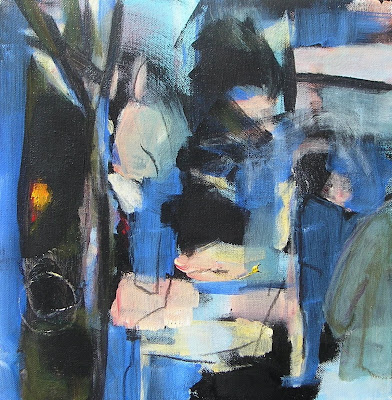
Here's a quick study for one I might call City People. Do you think it needs some fish?
 So long as you write what you wish to write, that is all that matters; and whether it matters for ages or only for hours, nobody can say. But to sacrifice a hair of the head of your vision, a shade of its colour, in deference to some Headmaster with a silver pot in his hand or to some professor with a measuring-rod up his sleeve, is the most abject treachery, and the sacrifice or wealth and chastity, which used to be said to be the greatest of human disasters, a mere flea-bite in comparison.
 Virginia Woolf
Went to see Bright Star, the new movie about John Keats. Really struck by how little critical praise or financial profit he received during his short life - he did not even have enough money to get to Italy that last year in order to convalesce and avoid another cold English winter - his friends had to come up with the money. If he had known about the book, "Do What You Love and the Money Will Follow," he certainly would have figured the money was following at a safe distance.
I remember hearing that orange is the least popular color in a painting while blue is at the top of the list. If Keats had been a painter, he would have just continued with puce if that had been his passion. But it is hard to not ever listen to a quiet voice saying, well, maybe just a nice blue painting to see if it sells quickly.
Here's Vuillard's Two Women at the Linen Closet. How does he get so much with so little out of those faces?
This is my only orange painting, Noon, inspired from a photo I took in Rome, not far from where Keats died in 1821 at the age of 25. Ready to sell to a color-blind individual.

 Pink is hard, at least for me it is. Can easily go toward sickly or Barbie. How does Gauguin make it work?
Riders on the Beach was painted in 1902.
Besides the pink struggle, there are always the composition problems. Sometimes, when trying to decide on the balance of shapes in a composition I'll put my hand a few inches from my face to block a figure and see if it seems necessary to a painting. In Riders, those 7 are absolutely necessary,don't you think? Also vital are those trees in the far left, providing some vertical opposition to all that horizontal movement. He just knows when to stop, too. There's a lot to draw your eye but areas for it to rest, as well. How he comes up with a painting filled with motion that seems so serene amazes me. Also, I find the figure on the left (with no horse) intriguing in that he seems to be not completely planted on the ground, but somehow pinned in place by some magical means, some tension created by his position relative to the other figures. Does this make any sense?
Here's a shot at using pink - a diptych of a ship at the dock in Bellingham with Lummi Island in the background. I lost the nerve to go strong and faded out the pink; the sky was very rosy when I took the picture. Maybe needs some punching up.

 With a great name like that, I guess I shouldn't have been surprised to read that he is a descendant of intellectuals whose friends included Emerson and Thoreau. I don't know why he does not seem to have the name recognition of his contemporaries (Rothko, deKooning, Diebenkorn, Park, for instance.)
While some of the painters he worked and studied with (Bay Area Figurative Artists) depersonalized their subjects, rendering faces in a more universal and less particular way, some of Brown's subjects are quite obviously distinct people. Here's a favorite of mine with its blazing blue eyes, entitled Portrait of D.K. (Don Knutson), 1964. I find it hard to use both red and blue without having them fight with each other or cancel each other out; these two hues he's chosen seem to enliven the other. In the book I have, the red in the upper left is saturated and glowing. Hard to see that here.
He also dashed off (well maybe they are not spontaneous but they look it) these small black and white portraits of Jack Kerouac and Allen Ginsburg.
Doesn't it seem like it may take more ability to know what to leave out as it does to nail down the features? Love those two lines on Ginsburg's forehead. (I'm starting to sound like Oprah - "love that!") The se were both painted in 1961 on
paper with oil and casein.
Hard not to look at these  without just giving up and putting away your sketch book forever.I was inspired to learn that Brown is 90 and still paints in San Francisco; his new work can be seen at Elins Eagle-Smith Gallery.
 Augustine may not have been the first to say this, but the words are often attributed to him.


 Posts
Posts


